




© Copyright 2022 Nezco Creative LLC. All Rights Reserved.

My biggest problem starting out on banjo was trying to bite off too much at once without learning the basics of
playing first. That's a common problem I see — people trying to go straight to "Foggy Mountain Breakdown"
without ever getting good at tuning, basic rolls, proper hand position and other basics.
In my opinion, these two issues need to be tackled right off when you're learning banjo. First, you need to have
a playable instrument that stays in tune and sounds decent, and second, you need to learn the steps to help
you walk before you run.
Here are some basics for banjo setup:
• The banjo itself needs to be decently put together. If it's a newer cheap instrument, chances are
it's playable enough. If it's an older cheap instrument, time, abuse or neglect might have rendered it
unplayable. A warped or out-of-adjustment neck, broken head, missing tuners, and other repair issues can be
expensive. If you have a cheap banjo with such problems, be prepared to hear a professional tell you it's not worth fixing.
• Give the banjo a new set of strings. I use light gauge strings, and have used about every major brand out there, and
they’re all pretty good.
• Get the banjo in tune using a pitch pipe, electronic tuner, piano, or, if you really have no idea, get a friend who plays
guitar or another musical instrument to help you.
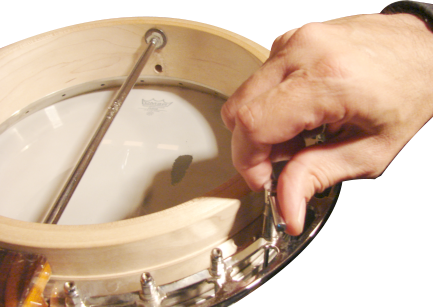
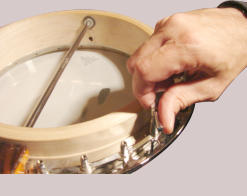
• Make sure the head is the proper tightness. Many banjo makers supply a head tightening key with the banjo. I
usually start on one side and work my way around a quarter-turn at a time. The head can be broken if you tighten it
too much, so be careful. You want to make sure it's a uniform tightness all the way round.
Many of these issues can be taken care of at your local music store. Better yet, if there’s someone nearby who
repairs musical instruments, they can probably handle the more complicated stuff. There are lots of very helpful
YouTube videos out there, as well.
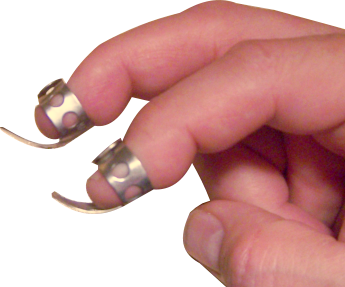
Putting on your fingerpicks for the first time will probably be
a weird experience. I remember putting mine on backwards at first.
My thinking was, they're just extensions of my fingernails, so they would go out from
my fingertips the same way, right? Then I tried actually playing that way, and it
wasn't long before I was turning them around.
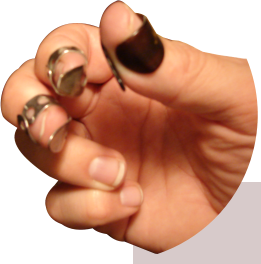
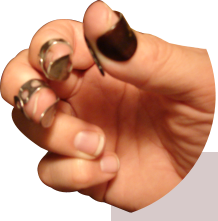
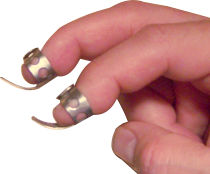
The picture at right is me wearing my favorite fingerpicks — a plastic National
thumbpick, large size, bent around to fit my thumb pretty tightly. I
bend the
pick (very carefully — I take no responsibility if you scald off your
fingerprints or something) by placing it in a shallow pan of boiling
water for a few seconds to soften the plastic. Then I take a pair of
needle-nose pliers to remove it and hold it, then use another pair to
bend around the curvy part and hold it in place while it cools. It may take
several tries and a bit of patience, but it can be done.
The fingerpicks are also Nationals. I've used the heaviest gauge Dunlops before, and they are more comfortable,
but I think these sound better, and they're not hard to get used to. Again, notice how they fit on my fingers, with the
extensions coming off the pads of my fingers, not my fingernails. I wear these pretty tightly as well, again bending them
around with needle-nose pliers. I don't bend the tips over as much as some, so they stick out quite a bit.
Speaking of right hand (I'll say "picking hand" for all you lefties), I'm not as dogmatic as
some about your picking hand position. Some prefer to have both the ring finger and the
pinky on the head of the banjo, a la Earl Scruggs. I can't do that, because when I move my
middle finger in to strike the string, my ring finger wants to move
with it. Maybe
it's a genetic thing — some can, some can't. I can't, and if
you can't, I wouldn't try to force you.
Some prefer a position where the ring finger
rests on the head and the pinky sticks
out. I've seen some very good banjoists
use this position. May work for you, just not for me.
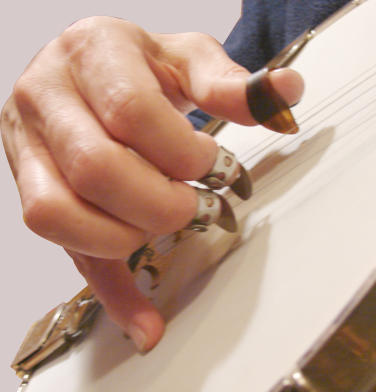
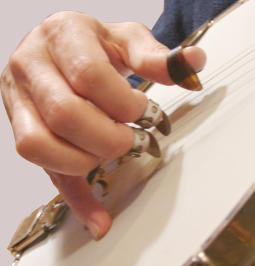
This photo shows the way I hold my right hand,
with
only the pinky resting on the head and the ring finger allowed to
"float." Here again, I know some excellent banjoists who use this
position.
Most players I've talked to don't really worry about how many fingers rest on the head of the banjo. They just do what works best for
them. I do think it's important to brace at least one finger on the head in order to get the stability necessary for even, precise picking. Some
claim it also dampens the head vibration just a bit so as to reduce overtones.
My advice would be to find what works best for you, then practice using only that position. Key word: practice.






© Copyright 2020 Nezco Creative LLC. All Rights Reserved.
My biggest problem starting out on banjo was trying to
bite off too much at once without learning the basics of
playing first. That's a
common problem I see
— people trying to go
straight to "Foggy
Mountain Breakdown"
without ever getting
good at tuning, basic
rolls, proper hand position and other basics.
In my opinion, these two issues need to be tackled right
off when you're learning banjo. First, you need to have
a playable instrument that stays in tune and sounds
decent, and second, you need to learn the steps to help
you walk before you run.
Here are some basics for
banjo setup:
• The banjo itself needs to be
decently put together. If it's a newer
cheap instrument, chances are it's
playable enough. If it's an older
cheap instrument, time, abuse or
neglect might have rendered it
unplayable. A warped or out-of-
adjustment neck, broken head,
missing tuners, and other repair
issues can be expensive. If you have a cheap banjo with
such problems, be prepared to hear a professional tell
you it's not worth fixing.
• Give the banjo a new set of strings. I use light gauge
strings, and have used about every major brand out
there, and they’re all pretty good.
• Get the banjo in tune using a pitch pipe, electronic
tuner, piano, or, if you really have no idea, get a friend
who plays guitar or another musical instrument to help
you.
• Make sure the head is the proper tightness.
Many banjo makers
supply a head
tightening key with the
banjo. I usually start on
one side and work my
way around a quarter-
turn at a time. The
head can be broken if
you tighten it too much, so be careful.
You want to make sure it's a uniform tightness all the
way round.
Many of these issues can be taken care of at your local
music store. Better yet, if there’s someone nearby who
repairs musical instruments, they can probably handle
the more complicated stuff. There are lots of very
helpful YouTube videos out there, as well.
Putting on your fingerpicks for the first time will
probably be a weird experience. I remember putting
mine on backwards at first. My thinking was, they're
just extensions of my fingernails, so they would go out
from my fingertips the same way, right? Then I tried
actually playing that way, and it wasn't long before I
was turning them around.
The picture at right is me
wearing my favorite
fingerpicks — a plastic
National thumbpick, large
size, bent around to fit my
thumb pretty tightly. I bend the
pick (very carefully — I take no
responsibility if you scald off your
fingerprints or something) by placing it in a shallow pan
of boiling water for a few seconds to soften the plastic.
Then I take a pair of needle-nose pliers to remove it
and hold it, then use another pair to bend around the
curvy part and hold it in place while it cools. It may take
several tries and a bit of patience, but it can be done.
The fingerpicks are also Nationals. I've used the
heaviest gauge Dunlops before, and they are more
comfortable, but I think these sound better, and they're
not hard to get used to. Again, notice
how they fit on my fingers, with
the extensions coming off the
pads of my fingers, not my
fingernails. I wear these
pretty tightly as well, again
bending them around with
needle-nose pliers. I don't bend the tips
over as much as some, so they stick out quite a bit.
Speaking of right hand (I'll say "picking hand" for all
you lefties), I'm not as dogmatic as some about your
picking hand position. Some prefer to have both the
ring finger and the pinky on the head of the banjo, a la
Earl Scruggs. I can't do that, because when I move my
middle finger in to strike the string, my ring finger
wants to move with it. Maybe it's a genetic thing —
some can, some can't. I can't, and if you can't, I
wouldn't try to force you.
Some prefer a
position where the
ring finger rests on
the head and the
pinky sticks out. I've
seen some very good
banjoists use this
position. May work
for you, just not for
me.
This photo shows the way I hold my right hand, with
only the pinky resting on the head and the ring finger
allowed to "float." Here again, I know some excellent
banjoists who use this position.
Most players I've talked to don't really worry about
how many fingers rest on the head of the banjo.
They just do what works best for them. I do think it's
important to brace at least one finger on the head in
order to get the stability necessary for even, precise
picking. Some claim it also dampens the head vibration
just a bit so as to reduce overtones.
My advice would be to find what works best
for you, then practice using only that
position. Key word: practice.


Page 5 -- Banjo Basics